Deelwoorden betekenis in het engels
Hoe is "deelwoorden" in Engels? Controleer de vertalingen van "deelwoorden" in het woordenboek Nederlands - Engels Glosbe: participles. Voorbeeld zinnen. Het Esperanto kent 6 verschillende vervoegingen voor de deelwoorden; actieve en passieve voor het verleden, heden en toekomst. Esperanto has six different participle conjugations; active and passive for past, present and future. Deelwoorden betekenis in het engels Het voltooid deelwoord (in het Engels: past participle) is de derde vorm van een werkwoord. Het wordt gebruikt samen met hulpwerkwoorden zoals “have”, “has” of “had”. Het verschil met de verleden tijd (past simple) is cruciaal, vooral bij onregelmatige werkwoorden.



Participles explanation
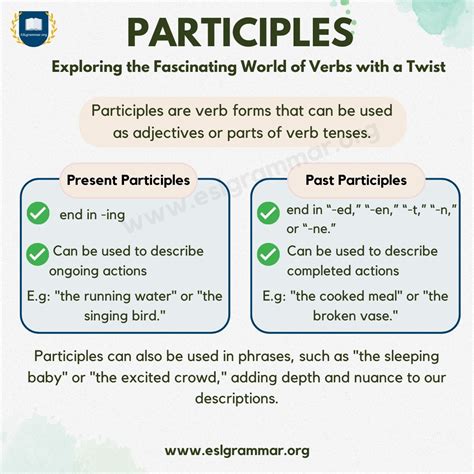
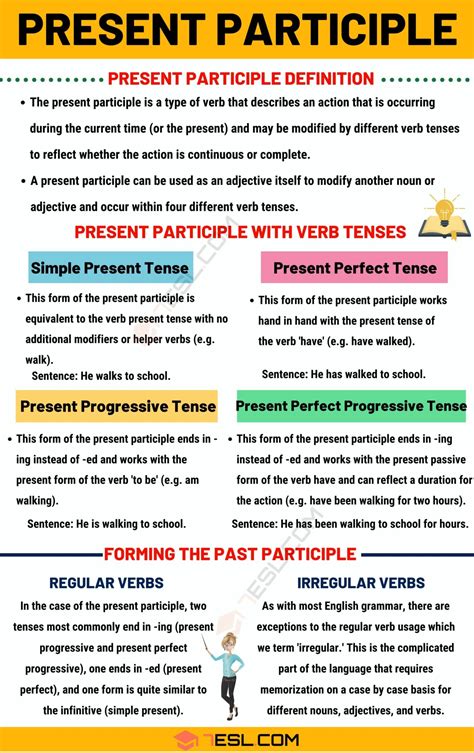
Participles are verb forms that act as adjectives or help form verb tenses, making them essential for clear, fluid writing. A participle functions as an adjective (“the hidden treasure”) or as part of a verb tense (“we are hiding the treasure”). There are two types of participles: Present participles: These end in -ing (e.g., hiding). Participles can be used as adjectives or to form certain verb tenses. Past participles typically end in “-ed.” Present participles always end in “-ing.”. Participles explanation In today’s post we are going to explain what participles are, consider some examples, and offer some tips for using participles correctly. What Is a Participle? A participle is a verb (action word) being used as an adjective.Past participle translation
In grammar, the past participle of a verb is a form that is usually the same as the past form and so ends in '-ed'. A number of verbs have irregular past participles, for example 'break' (past participle 'broken'), and 'come' (past participle 'come'). Translate verbs in context or find their definition. Conjugate an English verb with Reverso Conjugator at all tenses: indicative, past tense, participle, present perfect, gerund. See list of irregular verbs in English and conjugation models.- Past participle translation Conjugate the English verb translate: indicative, past tense, participle, present perfect, gerund, conjugation models and irregular verbs. Translate translate in context, with examples of use and definition.